Leak Repair
A refrigerant leak is one of the most misunderstood problems an air conditioning system can develop. Many homeowners notice that their home takes longer to cool, that energy bills climb month after month, or that the air coming from the vents simply is not as cold as it once was. These symptoms rarely point to a single dramatic failure. Instead, they usually trace back to a slow, quiet loss of refrigerant somewhere in the sealed loop that carries heat out of your home. Because refrigerant is not consumed during normal operation, a system that is low on refrigerant almost always has a leak. Finding and repairing that leak is the only lasting solution, and it is work that requires precision, the right equipment, and a methodical approach.
At Sunshine Air Conditioning we treat leak repair as a diagnostic discipline rather than a quick top-off. Simply adding refrigerant to a leaking system masks the problem for a short time while the underlying fault continues to worsen. Our approach is to locate the exact point of loss, repair the failure at its source, verify the fix, and then restore the system to the correct charge. This page walks through how we approach leak repair from the first symptom to the final performance check, so you understand what to expect when you call us.
Why Refrigerant Leaks Deserve Immediate Attention
Refrigerant is the working fluid that makes cooling possible. It absorbs heat inside your home at the evaporator coil and releases it outside at the condenser coil. The entire cycle depends on the refrigerant being sealed inside the system at a specific pressure and quantity. When even a small amount escapes, the balance of the system changes. Pressures drop, the compressor works harder, and cooling capacity falls off. A system that is undercharged for a long period is far more likely to suffer a compressor failure, which is by a wide margin the most expensive repair an air conditioner can need.
There is an environmental and regulatory dimension as well. Modern refrigerants are handled under strict rules, and older refrigerants such as R-22 are increasingly scarce and costly. Continuing to refill a leaking older system becomes financially draining because the refrigerant itself grows more expensive every year. Repairing the leak protects both your wallet and the equipment. In the heat of a Florida summer, a leaking system also runs nearly nonstop trying to reach a temperature it can never achieve, which accelerates wear on every component and drives up your electric bill.
How We Locate a Leak
Finding a leak is often the hardest part of the job because refrigerant escapes as a gas and leaves no visible trail. Over decades of service across The Villages, Summerfield, Silver Springs Shores, Leesburg, On Top of the World, Tavares, Okahumpka, Lady Lake, Belleview, Ocala, Weirsdale, Fruitland Park, Mount Dora, Eustis, Groveland, Clermont & Marion Oaks, FL areas, we have refined a layered detection process that combines several methods so nothing is missed. We do not rely on guesswork or a single tool. Instead, we confirm the presence of a leak, then narrow down its location, then pinpoint the exact spot before we open the system.
- Visual and oil-trace inspection: Refrigerant carries a small amount of lubricating oil. When a leak develops, oily residue often collects around the failure point, giving us an early clue at fittings, joints, and coil surfaces.
- Electronic leak detection: We use sensitive electronic detectors that respond to trace amounts of refrigerant in the air, allowing us to sweep along coils, line sets, and connections to find rising concentrations.
- Ultraviolet dye testing: For slow or intermittent leaks, we introduce a fluorescent dye that circulates with the refrigerant and glows under UV light at the escape point, which is ideal for leaks that hide until the system has run for a while.
- Nitrogen pressure testing: When a leak is suspected but elusive, we isolate the system and pressurize it with dry nitrogen, then watch for pressure loss that confirms and helps localize the fault.
- Bubble solution verification: At accessible joints and fittings, a specialized bubble solution reveals escaping gas directly, giving a clear visual confirmation before we commit to a repair.
The Repair Process from Start to Finish
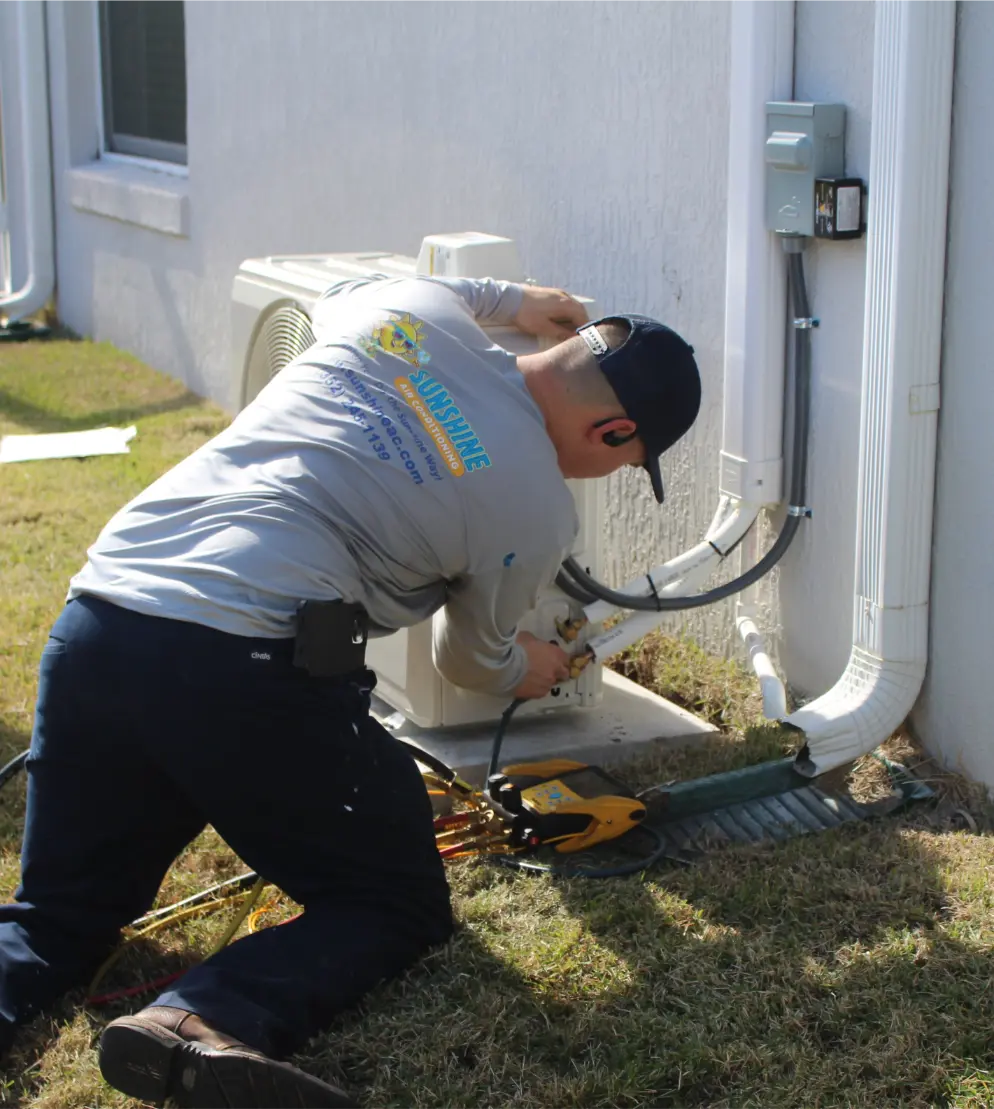
Once we confirm where the refrigerant is escaping, we move into the repair itself with a clear sequence. First we recover the remaining refrigerant using a certified recovery machine so that nothing is vented to the atmosphere. This step is both a legal requirement and a matter of responsible practice. With the system safely emptied, we access the failed area and make the appropriate repair. The nature of that repair depends entirely on where the leak is.
Common repair points include brazed joints on the copper line set, flare connections at the service valves, Schrader valve cores that have worn out, and coil surfaces that have corroded over time. A worn valve core might be a simple replacement, while a corroded evaporator coil often calls for coil replacement because pinhole leaks in aluminum or copper coils tend to multiply. When we braze a joint, we do so while flowing nitrogen through the line to prevent oxidation and scale from forming inside the pipe, which protects the system from future contamination.
After the physical repair is complete, we pull a deep vacuum on the system with a micron gauge to remove all air and moisture. Moisture is an enemy of any refrigeration circuit because it reacts with oil and refrigerant to form acids that damage the compressor from the inside. We hold the vacuum and watch the micron reading to confirm that the repair is truly sealed and that no moisture remains. Only then do we recharge the system to the manufacturer’s specified weight, measured precisely rather than estimated. Finally we run the system, check superheat and subcooling, verify pressures, and confirm that the home is cooling as it should.
Technical Details That Guide a Lasting Repair
Precision matters at every stage of leak repair. Refrigerant charge is specified by weight, and even a small deviation affects efficiency and longevity. We measure charge using calibrated scales and verify performance using superheat and subcooling readings that tell us whether the charge is truly correct for the operating conditions. Ambient temperature, indoor load, and airflow all influence these numbers, which is why we test under actual running conditions rather than relying on pressure alone.
The type of refrigerant in your system also shapes the repair. Systems using R-410A operate at higher pressures than older R-22 systems, which changes how joints are stressed and where leaks tend to appear. Newer systems entering the market use additional refrigerant types, and each requires the correct recovery, handling, and recharge procedure. We match our tools and materials to your specific equipment so the repair is compatible and durable. In our humid climate, we also pay close attention to coil corrosion, since salt air and constant moisture accelerate the formation of the tiny pinholes that cause many evaporator leaks.
Why Homeowners Rely on Sunshine Air Conditioning
We have served this community for a long time, and leak repair is a core part of what we do. Sunshine Air Conditioning, Inc. was founded in 1990, and that experience shows in how thoroughly we diagnose and repair rather than simply refill. Every repair is backed by our 100% satisfaction guarantee, so you can trust that we stand behind the work long after we leave your home. When a leak leaves you without cooling, our 24/7 emergency service means help is available whenever you need it, not just during standard hours.
We also understand that an unexpected refrigerant leak, especially one that leads to a coil or compressor replacement, can be a significant expense. For qualifying projects we offer Wells Fargo Financing with approved credit, giving you a way to move forward with a proper repair rather than delaying it and risking further damage. From the first phone call to the final performance check, our goal at Sunshine Air Conditioning is to make the process convenient, transparent, and complete, so your system runs cool and efficient through every Florida summer to come.

Now Offering Flexible Financing
Keeping you and your family comfortable all year long. Subject to approved credit.